We earn a commission if you buy through links on this page, at no extra cost to you. It never decides what we recommend. Prices checked Nov 26, 2026; deals can change.
The short version
- DataCamp Premium is $132 for the first year during the Black Friday sale, down from $330.
- The Associate AI Engineer for Developers track is the strongest buy for software developers moving into AI work. It runs 29 hours across 10 courses and ends with MCP and LangChain.
- There is no forward deployed engineer track. DataCamp can cover the technical half of that role, but not the customer-facing half.
- Several useful AI courses (n8n, Claude Code) are free. Premium pays off when you work through full tracks and certifications.
AI didn't replace the engineer. It changed the job description.
Two years ago, "AI engineer" mostly meant someone who trained models. In 2026 it usually means someone who calls a model through an API, grounds it in a company's data, connects it to tools and keeps it working once real users arrive. That is a software job with new parts, and most developers learned none of those parts in school or at their last job.
New titles have followed. The forward deployed engineer (FDE), a software engineer who embeds with a customer to build and run software inside that customer's own systems, has gone from a Palantir specialty to a common listing at AI companies. Indeed data reported by Business Insider shows FDE postings rising from 643 in April 2025 to 5,330 in April 2026. AI automation roles, built around tools like n8n and agent frameworks, have grown alongside them.
The gap between what these roles ask for and what most résumés show is real. It is also learnable. The question for this Black Friday is whether DataCamp's catalog actually teaches the current version of those skills, or a 2023 version with a new label.
We went through the tracks and course pages to find out.
What the Black Friday deal gets you
DataCamp's promo page lists Premium at $132 for the first year instead of $330, and Teams at $132 per user for the first year. Premium unlocks the full catalog: courses, career and skill tracks, certifications and projects. DataCamp lists 810+ courses.
DataCamp says this is its biggest sale ever. For context, its 2025 Black Friday sale topped out at 55% off, so 60% is a real step up.
See the DataCamp Black Friday offer
Which DataCamp track fits which AI role
Matching DataCamp tracks to 2026 AI roles
| Role | Best DataCamp starting point | Time | What it won't cover |
|---|---|---|---|
| AI engineer (developer) | Associate AI Engineer for Developers | 29 hrs, 10 courses | Deployment code; RAG is light |
| AI engineer (data scientist) | Associate AI Engineer for Data Scientists | 40 hrs, 13 courses | App-building with LangChain |
| Forward deployed engineer | AI engineer track + data engineering and API courses | Varies | Customer discovery, on-site delivery |
| AI automation engineer | n8n courses + AI Agent Fundamentals | ~16 hrs | Production engineering depth |
| ML engineer / MLOps | Machine Learning Engineer | 44 hrs, 12 courses | Assumes you already train models |
AI engineer: the clearest reason to buy
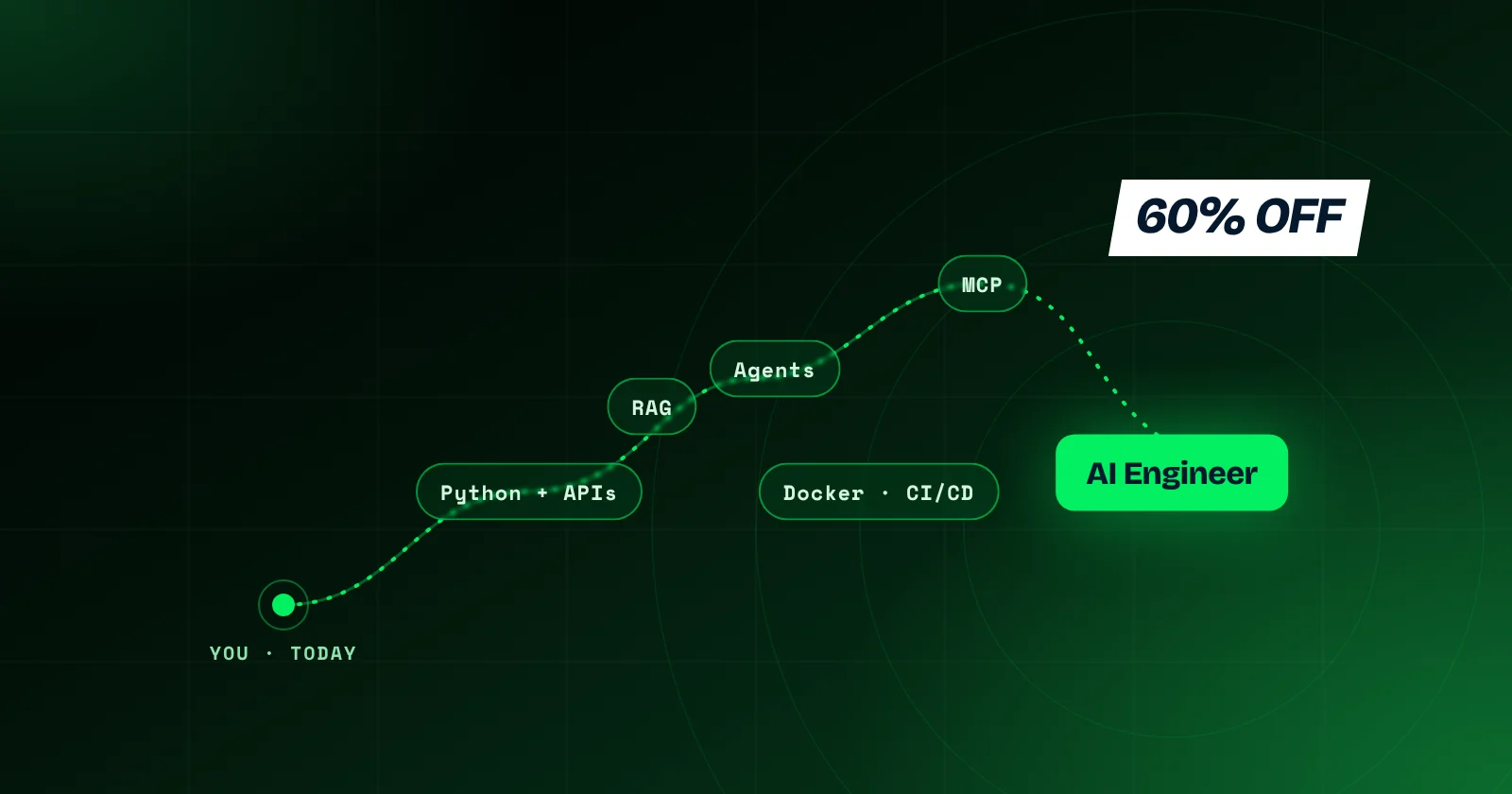
The Associate AI Engineer for Developers track is aimed at people who already write Python and want to build with large language models. Its 10 courses move in a sensible order: working with the OpenAI API and its newer Responses API, prompt engineering, Hugging Face, embeddings, the Pinecone vector database, software engineering principles in Python, LangChain and, at the end, the Model Context Protocol (MCP), which has become the standard way to plug tools into AI agents.
That last course is the strongest sign the track is current. DataCamp's MCP course was refreshed in June 2026, and its LangChain agent material was updated in July 2026. The track also comes with an AI Engineer certification at no extra cost on Premium.
Where it stops short: the track's LLMOps course is conceptual and does not include deployment code, and retrieval-augmented generation (RAG) gets only a first pass. If you want production habits, add Deploying AI into Production with FastAPI and Retrieval Augmented Generation (RAG) with LangChain, which DataCamp updated in September 2026. Both are included in Premium.
Coming from data science rather than software? The Associate AI Engineer for Data Scientists track (40 hours, 13 courses) leans toward training, fine-tuning and MLOps instead.
Forward deployed engineer: useful, but no shortcut
DataCamp does not offer a forward deployed engineer track, and no online course can fully prepare you for one. The role is half engineering and half consulting. DataCamp's own guide to the job lists the core skills as software engineering fundamentals, systems integration, customer communication, product judgment and comfort with undefined problems.
DataCamp can credibly cover the first two. The AI engineer track above handles the LLM side, and its data engineering tracks and Introduction to APIs in Python cover the integration work of connecting a platform to customer data and systems. The customer-facing half (scoping a vague problem, explaining trade-offs, owning a deployment) comes from projects and real work, not videos and exercises.
If you're aiming for FDE roles, use DataCamp to fill your technical gaps quickly, then spend your time on a portfolio project that solves a messy, real problem from start to finish.
AI automation engineer: start free, then decide
DataCamp has three n8n courses: Introduction to Workflow Automation with n8n (3 hours, beginner, no coding), Intermediate Workflow Automation with n8n (4 hours, covering scheduled, error-tolerant automations that call APIs) and Building Marketing Workflows with n8n. Add the beginner-friendly AI Agent Fundamentals track (6 hours across 3 courses) for agent concepts like multi-agent patterns and the Agent-to-Agent (A2A) protocol.
One honest note: the introductory n8n course is free on DataCamp. Take it first. If you enjoy the work, Premium makes sense for the agent material, the intermediate automation work and the rest of the catalog.
ML engineer: the most complete technical track
The Machine Learning Engineer track runs 44 hours across 12 courses and covers what happens after a model is trained: MLflow, data versioning, monitoring for drift, Docker and CI/CD with GitHub Actions. DataCamp positions it for junior ML engineer roles.
It assumes you can already manipulate data and train models in Python, even though it lists no formal prerequisites. Start here only if that's true.
The Docker course in this track has a fan on our team. The White Owl's editor, Asiful Alam, took DataCamp's Docker course about two years ago and found it effective. He hasn't taken the AI tracks covered here, so the rest of this guide is based on DataCamp's course pages rather than hands-on testing.
Using AI coding tools at work
If your goal is to stay sharp in your current developer job rather than switch roles, DataCamp's Claude Code 101 and Claude Code in Action courses are free and were updated in mid-2026. The AI for Software Engineering track (8 hours) covers GitHub Copilot, Windsurf and Replit workflows.
Where DataCamp falls short
- Interactive exercises are not a portfolio. The browser-based format is great for learning syntax and concepts quickly. Hiring managers for AI roles still want to see something you built and shipped. Use DataCamp's projects as a starting point, not the finish line.
- Some tracks are conceptual where jobs are practical. LLMOps Concepts teaches the lifecycle without deployment code. You will need to add the FastAPI or MLOps courses to close that gap.
- The certification is a signal, not a credential. It can help you stand out, but it won't replace experience in a hiring process.
- The price is a first-year price. Check the renewal terms at checkout before you buy.
Should you buy DataCamp Premium this Black Friday?
Whichever path fits, pick one track before you pay and block out the hours for it. A year of access only matters if you actually finish something.